
No Hawker aircraft has remained operationally viable for as long as the Hunter. UK-based defence contractor HHA — Hawker Hunter Aviation — demonstrates this.
Is the elegant Hawker Hunter akin to a grandfather clock? Allow Mat Potulski, managing director of HHA, to explain. “If you wind it up and maintain it”, he says, “it will work”. That’s an important attribute in the world of defence contracts, providing support to armed forces and industry, where reliability and sortie success rates are key benchmarks.
Not every task requires a so-called fourth or fifth-generation fighter, the likes of a Eurofighter Typhoon or Lockheed Martin F-35, nor even one of today’s breed of ever more capable advanced jet trainers. Indeed, to use such platforms for secondary costs are so high. No wonder some of the world’s air arms are turning to contractor support.
This is where aircraft like the Hunter still enter the equation. It was with this in mind that Hawker Hunter Aviation, to give HHA its full name, was founded in 2000. While its work has evolved since then, and it has acquired some other types, the Hunter remains the core of the business, a remarkable achievement given how the type first flew nearly 70 years ago.
It’s further testament, as if it were needed, as to the essential ‘rightness’ of Sydney Camm’s early- 1950s design.
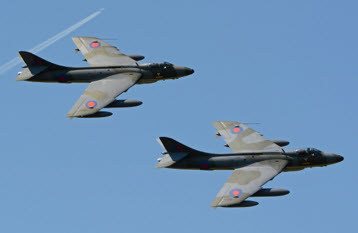
The former Swiss Hunters — these are ZZ190 and a pre-repaint ZZ191 — offered an excellent combination of high-quality maintenance and equipment levels, plentiful spares and the ‘big’ Avon 200-series engine. ANDY SHELTON
The core of the original fleet was formed by the ex-Swiss Air Force Hunter F58 and F58A models acquired by the Old Flying Machine Company during the mid-1990s.
They were soon joined by many more, as HHA built up its inventory to the point where, today, HHA owns 14 Hunters, nine of which are to be found at the company’s RAF Scampton base. But, to ask an age-old question, why choose the Hunter in the first place?
“For a long time”, comments Mat Potulski, “defence budgets have been under pressure with rising unit costs and ever more tasking commitments. I started to think that governments must be interested
in saving cost and could benefit from outsourcing some of the secondary training activities, such as threat simulation, thereby saving front-line aircraft from expensive usage and fatigue.
This is something that’s been happening in the US for the past two decades, and indeed huge contracts — in excess of 50,000 flying hours — have recently been awarded to contractor companies undertaking similar activities of that nature in the USA.
“That was the thought that came to Mark Hanna and I in the mid-to-late 1990s. To do this we had to find a platform which had a low through-life cost but could meet all the performance criteria we were looking for. At the time we didn’t need something that was supersonic, or had a radar. We needed something with a performance plus margin over the Hawk.
“The aircraft for us are air vehicles, an aerial Transit van which needs to have a certain performance envelope and carry items of equipment to generate the required effect. Supportability and sustainability are also key considerations, together with the ease of integrating upgrades to deal with obsolescence issues on the avionics, comms and situational awareness side. For that purpose the Swiss Hunters were ideal.
“I say the Swiss Hunters because the Swiss not only maintained their aircraft very well, but they also exhibited very low fatigue and flying hours. While it is a ‘legacy’ — older-generation — platform, the performance it can deliver and the reliability it has are very good, as evidenced by our current 98 per cent sortie success rate. Spares are still readily available as well. That is why, after a fairly extensive selection programme where we looked at different types ranging from Alpha Jets to Sabres and the L-39, L-59 and L-159 range, we chose the ex-Swiss Air Force Hunter airframes to try to deliver the services we thought would be required.
“However, it’s not the immediate tactical requirements that lead to contracts being issued by the customers such as the MoD. This has to come via a statement of requirement, which in turn leads to the allocation of financial resource, and only then is a potential tender submitted which interested parties can compete [for].
As you can imagine, this can be a somewhat time-consuming process. Therefore, whilst the company was set up to provide threat simulation services mirroring the US approach, the reality of what we currently do as our ‘bread and butter’ is actually the provision of trials platform aircraft for defence training, test and evaluation and what are now known as capability enhancement activities.

In essence, we free up front-line resources from having to undertake these industry-related activities and ensure that industry has a military-compatible platform available at short notice as and when required rather than being at the bottom of a squadron’s tasking order. In the meantime, we are, of course, also keeping a beady eye on what threat simulation activities the MoD and other NATO governments wish to undertake.”
Uniquely, HHA’s aircraft operate on the UK military register. The Air Navigation Order largely prohibits commercial activities being undertaken with aircraft of military design origin when operating on the civil register, in addition to severely constricting their operating envelope. Clearly this would prevent the sort of work HHA embarks on.
But being on the military register is not an easy matter. It has to be justified via a complex process, on the basis of the required usage of the aircraft and demonstrating there is no practical, available alternative to meet the clearly articulated tasking requirements.
For HHA, being on the military register enables seamless integration with the defence community and military clients. Potulski says, “It provides the customer with the assurance that the rigour we apply to our safety management systems, our training, our spares procurement and every aspect of our operation at the very least mirror those of the user community, hence us being completely interoperable with military ranges, military procedures, military airfields and other military aircraft.”
It is not possible to divulge details of HHA’s specific recent taskings, as many of them relate to classified projects. However, past examples offer a flavour of the firm’s expertise. Its Hunters provided the fast jet flying in support of developing the Principal Anti-Air Missile System (PAAMS), otherwise known as Sea Viper, for the Royal Navy’s Type 45 destroyers.
Similar work was carried out for BAE Systems as it honed the air defence systems of naval vessels being supplied to Middle Eastern customers. For a missile manufacturer it undertook the aerial trials of a ship-based air defence weapon, which involved the creation of a specific trials platform aircraft by modifying two-seat Hunter T8B XF995 to carry, amongst other things, a nose-mounted missile seeker head.
The latter example demonstrated another of HHA’s capabilities. The company holds Contractor Flying Approved Organisations Scheme (CFAOS, including flight test), Maintenance Approved Organisation Scheme (MAOS), Design Approved Organisation Scheme (DAOS) and Continuing Airworthiness Management Organisation (CAMO) approvals issued by the Military Aviation Authority. This suite of approvals enables it to modify, test and operate aircraft embodying customer- specific equipment, ranging from internal carriage to the creation of specific trials platform aircraft with bespoke stores carriage and flight test observer instrumentation.
Says Potulski, “The aircraft used can be a single-seater or a two- seater — it may or may not have to carry a customer flight test observer who we’ve trained up for fast jet flights. It can be a single-seat Hunter used as a chase platform, or itself carrying trials equipment, or a combination of the two where the two-seat trials platform aircraft will interact with one or two — or more — of our single-seat aircraft acting as co-operative targets for radar trials.”
In a different vein again, as Hunter subject matter experts, HHA assisted the Air Accidents Investigation Branch in producing its report on the Shoreham accident involving privately owned and operated Hunter T7 WV372/G-BXFI. Since HHA’s aircraft are military- registered, they were not subject fast jet flights.
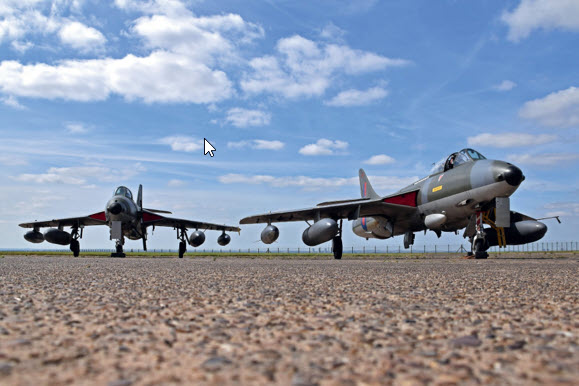
It can be a single-seat Hunter used as a chase platform, or itself carrying trials equipment, or a combination of the two where the two-seat trials platform aircraft will interact with one or two — or more — of our single-seat aircraft acting as co-operative targets for radar trials.”
In a different vein again, as Hunter subject matter experts, HHA assisted the Air Accidents Investigation Branch in producing its report on the Shoreham accident involving privately owned and operated Hunter T7 WV372/G-BXFI.
Since HHA’s aircraft are military- registered, they were not subject to the order grounding all UK civilian-registered Hunters in the wake of the crash. F58 ZZ190 duly flew three data-gathering sorties on behalf of the AAIB in October and November 2015.
A regular assignment since 2006 has been co-operation with QinetiQ and the Empire Test Pilots’ School at Boscombe Down. “That’s an ongoing requirement where we provide either a single- or two-seat aircraft for various activities there”, says Potulski. “The single- seat aircraft are frequently used as formation chase aircraft. Also the students undertake what are called qualevals [qualitative evaluations], where they have to assess an aircraft, we offer a two seater Hunter for this rolewhich enables them to write an assessment report as to the handling, the flying characteristics and the proficiency of an aircraft in a certain role.”
The Hunter’s proficiency for the work HHA undertakes remains largely undiminished. As plenty of other examples prove, successful aircraft designs can remain viable for a lot longer these days than did their predecessors. Attributes such as agility, systems and stealth are what mark the newer generations of combat jets out — and cost, of course. But for a company like HHA, the performance of a Hunter modified with modern ‘glass’ cockpit avionics and comms is still perfectly competitive in the modern air environment. Compare it to the latest marks of Hawk, for instance. While the Hunter’s classic systems may be less advanced, its flight performance stacks up. And with TCAS (traffic collision avoidance system), GPS approach aids, countermeasures dispensers and radar warning receivers they come well-
equipped for aircraft of their era and continue to be an effective subsonic platform.
Each of HHA’s flying Hunters notches up somewhere in the region of 100 airframe hours a year. This level of utilisation means they have plenty of life left. In any case, these are all low-time airframes. The fleet leader has just clocked up slightly over 3,000 hours — or, to put it another way, about a third of the highest- time Hawk T1s.
Out of a large fleet, comprising 14 aircraft in all, three — soon to be four — are flown regularly. “The other airframes are there not just as attrition reserves”, Potulski says, “but principally if we were to embark on undertaking one of the threat simulation contracts I referred to. If the likes of the MoD’s cancelled ASDOT [Air Support to Defence Operational Training] project had happened, we could have generated extra aircraft from our current stored fleet. But, at the moment, we can do everything we are tasked to do with the aircraft we are currently operating on the military register”. These are F58s ZZ190, ZZ191 and ZZ194, and newly flown T72 XE688.
All HHA Hunters are now powered by the Rolls-Royce Avon 200-series engine, which is not only more reliable and powerful than the 100-series, but has the crucial advantage that overhaul facilities still exist. In contrast to this, the Avon 100 units — known as ‘small’ or ‘little’ engines — cannot currently be overhauled, which has led to the grounding and subsequent storage for spares recovery purposes of the four Avon 100-powered aircraft in HHA’s fleet. “You cannot readily convert a little-engined Hunter into a big- engined Hunter, or vice versa”, explains Potulski. “They did it in the factory because they had all the jigs, but to do it outside the factory is a monumental task. Hunter T8B XF995 was our little-engined two-seat Hunter, and it had a compressor blade failure about four years ago. We very quickly identified the fault, but there wasn’t a repair scheme for it. We couldn’t just take another Avon 100 unit out of a box and put it in because we didn’t know whether that same fault could readily reoccur and cause an accident. So, we elected to ground the Avon 100 aircraft and stop work on further Avon 100-powered two-seat Hunters which we were overhauling.
“Then we looked around for an Avon 200-series trainer version which was potentially for sale. These aircraft are like hen’s teeth, but we had been providing through- life support for one that Embraer had been operating for more than
a decade. We approached Embraer with a request that we would like to purchase that aircraft, which we did, and we shipped it back from Brazil to Britain.”
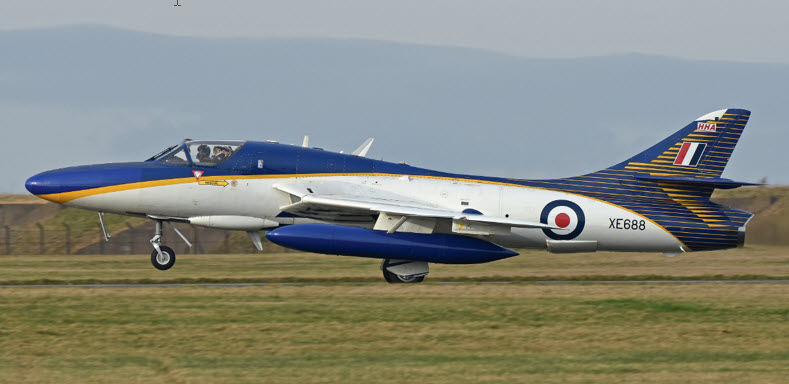
The aeroplane in question is a Hunter T72, formerly registered PP-XHH. It started life as an RAF F4 with serial XE688 before being returned to Hawker and undergoing two-seat conversion for the Chilean Air Force. Upon
retirement, the airframe became a technical training aid, but was then purchased by Embraer as a flight test chase aircraft and returned to airworthiness during 2001. It arrived with HHA in the late summer of 2018, going into, Potulski says, “an extensive modification and overhaul period, those modifications being not only to put in a ‘glass’ cockpit but also to prepare it as a trials platform aircraft to carry various pieces of internal and external customer equipment”. The T72 has joined the other HHA steeds on the military aircraft register, taking up its old identity of XE688 once again. It took to the air again at Scampton on 29 January this year.
The entire fleet will, over time, go into the ‘splinter’ camouflage first seen on ZZ191 in 2018, or variations thereof. “We were fed up with people coming up to us and asking what we were doing in the 21st century with an aircraft their grandfather flew”, Potulski comments. “It was as if the pedigree, the history and the sheer beauty of line of the Hunter was a detriment in the sense of people associating it with the past.
They do so quite rightly, because it’s got a great track record, but it was a negative for us in terms of perception. Our aircraft are not museum-pieces — we want them to look contemporary and project the image that they are still credible training and test and evaluation platforms delivering effect right now. I call it the Marmite scheme — you either love it or loathe it.”
With new contracts, staff expansion and the potential for additional types in the offing, HHA is well-placed in its sector. As Potulski describes, “The company will continue to provide the fast jet research and development trials support platforms that it currently provides to our expanding client base, whilst it’s poised to embrace the fast jet threat simulation market as and when opportunities present themselves.”
Turning to the subject of different aircraft types, he said, “We are not wedded to the Hunter. In my opinion it is currently one of the best tools for the job and will remain the bedrock of the company for a considerable time. But varying contractual requirements may require us to obtain types whose performance envelope differs from the Hunter. If that is the case, then the company is well poised to utilise its suite of regulatory approvals and expertise in regenerating aircraft to operate types new to HHA.”
But, for the moment, Hawker’s masterpiece remains at HHA’s core, and should remain so for many years to come. The grandfather clock isn’t yet ticking for these classic jets
Not Just Hunters
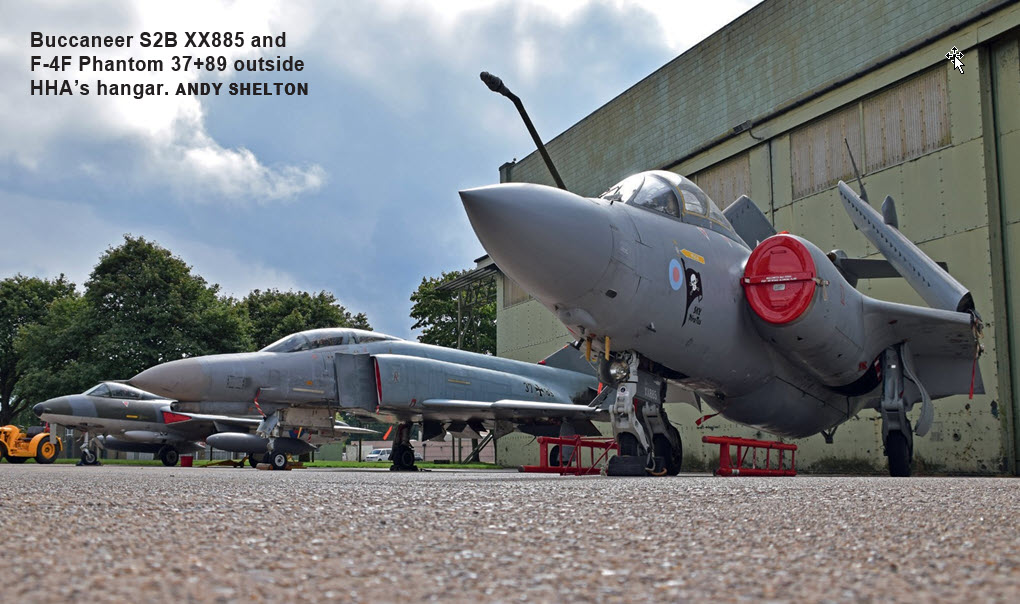
HHA has the approach that if a customer requires a capability that falls outside that of the performance envelope of the Hunter, then it will examine the suitability of alternative air systems to generate the required effect. This approach led to the acquisition of a Sukhoi Su-22 and a Buccaneer S2B, both of which are currently in inhibited storage.
At present the company is examining the practicality and through-life cost of operating an ex-Luftwaffe F-4F Phantom, and has already acquired a ground instructional airframe to aid the assessment process.
“We have taskings that require a supersonic platform which also has access to modern radar systems”, says Mat Potulski.
The ex-GermanF-4F with its ICE (Improved Combat Efficiency) upgrade fits that bill, to say nothing of the fact that the Luftwaffe jets were well-maintained, with ample spares stocks. Potulski continues, “It is perhaps surprising that one of the safety case attributes of ‘legacy’ platforms in the roles we use them for is that they do not have a flight management system and rely on mechanical rather than digital flying controls.
This makes the integration of modern avionic and threat emulation systems a far easier process from an EMC [electromagnetic compatibility] clearance perspective than would be the case with more modern aircraft. In essence, electronic emissions won’t interfere with the actual flying controls of the aircraft.
From that perspective the F-4F Phantom can be seen as being similar to the Hunter — another grandfather clock, albeit this time with a lot more modern systems as standard.”
